1888/9


Picture Collection - Worcestershire Museum of Freemasonry
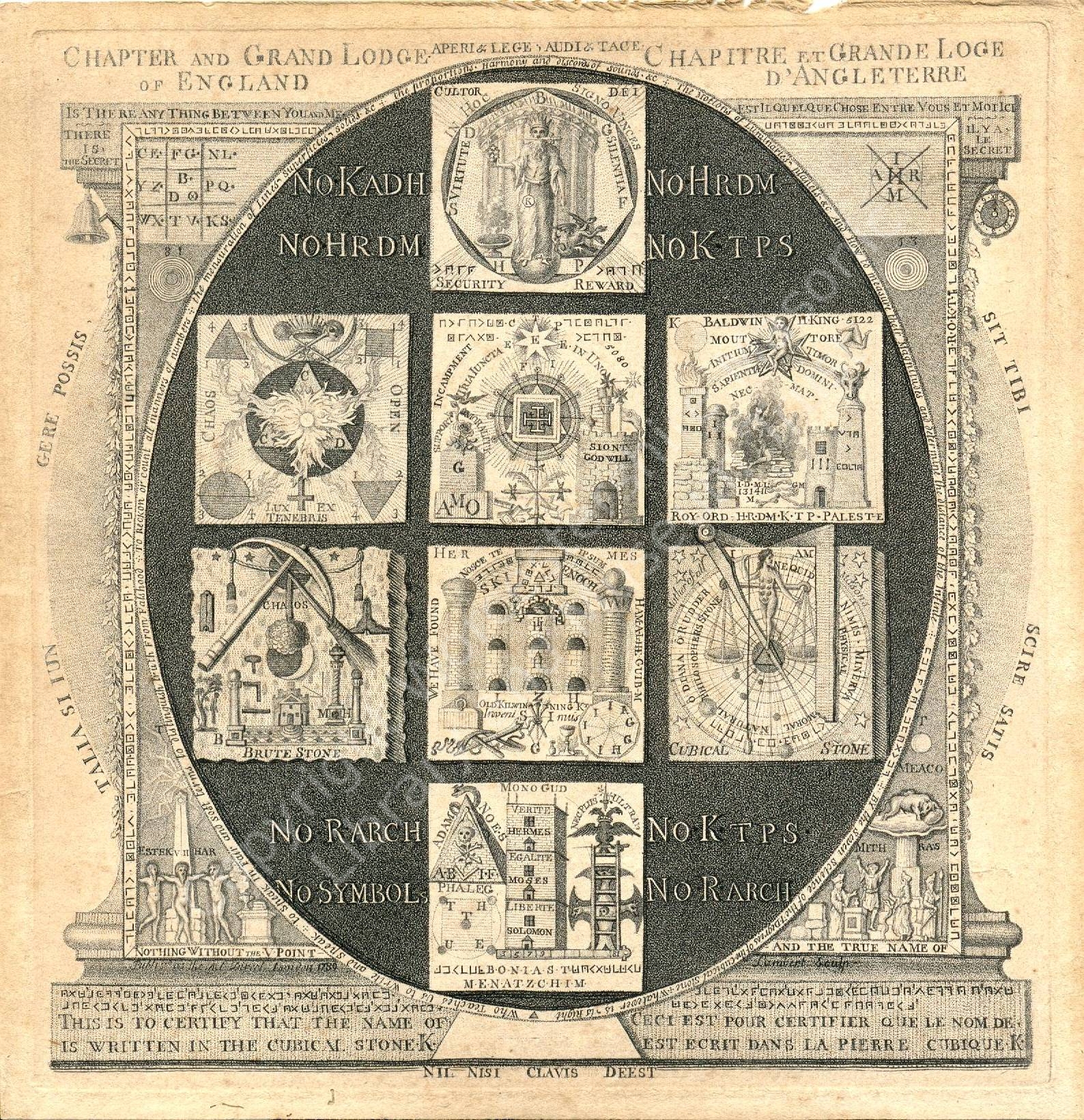
Chapter and Grand Lodge of England - P Lambert 1879
WMLMT Classification:- Print/Plate
Description
"The French / English engraver Peter Lambert is best known for his Masonic engravings
The print is of Masonic design, with eight squares within an oval, against a rectangular decorated plinth, with inscriptions both in English and French, and is inscribed ‘Publisd. as the Act direct. London 1789 / Lambert sculp'. The French / English engraver Peter Lambert (also known as Pierre Lambert de Lintot) was Master of Lodge 53 in 1787, and lived at 5 Cobham Row, Cold Bath Fields, London.
The top of the print is inscribed: CHAPTER AND GRAND LODGE OF ENGLAND; and the bottom inscribed: THIS IS TO CERTIFY THAT THE NAME OF … IS WRITTEN IN THE CUBICAL STONE .K. and NIL NISI CLAVIS DEEST (Nothing is missing except the key).
The meaning of the eight squares depicted in the oval is given in the 1890 AQC article ‘A Symbolical Chart of 1789’, by G. W. Speth, as follows:
- The top square is the Carpet or Floorcloth of the Degree of Knights of the East and West, surrounded by the letters B. D. S. H. P. F. and G., signifying Beauty, Divinity, Strength, Honour, Power, Fidelity, and Glory.
- On the second line, the left-hand square represents the Birth of Light from Darkness; the middle square the emblems of the Degree of the Rose Croix; and the right-hand square an allegorical representation of the Order of Harodim (Royal Order of Scotland).
- On the third line, the left-hand square represents the Brute Stone (Rough Ashlar); the middle square the Arches of Enoch (built to protect sacred knowledge and the ineffable name of God from being lost in the upcoming Great Flood); and the right-hand square the Cubical Stone (Perfect Ashlar), which, according to the inscription at the foot of the print, contains the Sacred Name.
- The bottom square has a diagram of the Degree of Prussian Knights, or Noachites.
The top left and right appear to give a key to translate the cipher at the base and around the rectangle, but this is spurious. Speth, however, deciphered the legend at the bottom left using a different key, as follows:
- And will give him a white stone and a new name which no man knoweth it I will make a pillar and write the name of the city and write my new name divinity support morality.
Within the oval from top left: NO KADH NO HRDM / NO HRDM NO KTPS / NO KTPS NO R ARCH / NO R ARCH NO SYMBOL. Reading backwards and translating as: No Symbolic Degrees (1st, 2nd, and 3rd), No Holy Royal Arch / No Holy Royal Arch, No Knight Templars / No Knight Templars, No Rose Croix of Heredom (18th degree) / No Rose Croix of Heredom, No Knight of Kadosh (30th degree).
Around the outer circle from the bottom left is the following Latin inscription: TALIA SI JUNGERE POSSIS SIT TIBI SCIRE SATIS (If you would understand these things you would know enough).
Around the oval from the bottom centre is the following hermetic / alchemic inspired inscription:
 Who teaches us to write and speak. to speak in fair and soft terms to distinguish truth from falshood.
 To reckon or count all manners of numbers.
 The mensuration of lines, superficies, solids, &c.
 The proportions, harmony and discords of sounds, &c.
 The motions of luminaries, planets, &c.
 And how to measure their magnitudes and determine the distance of the infinite
 [undeciphered runes]
 By the seven science of the 7 degrees of the cubical stone.
 Whatever is, is right
Further, non-masonic, explanations of the iconography within the squares can be found in the 1987 Hermetic Journal article ‘Hermetic Symbolism in a Masonic Engraving’, by Adam McLean."
Use Your Browser Back Button to Return to Previous Page
Quick Links:- Return to Picture and Print Collection - Browse All the Museum Collections
