1888/11


Picture Collection - Worcestershire Museum of Freemasonry
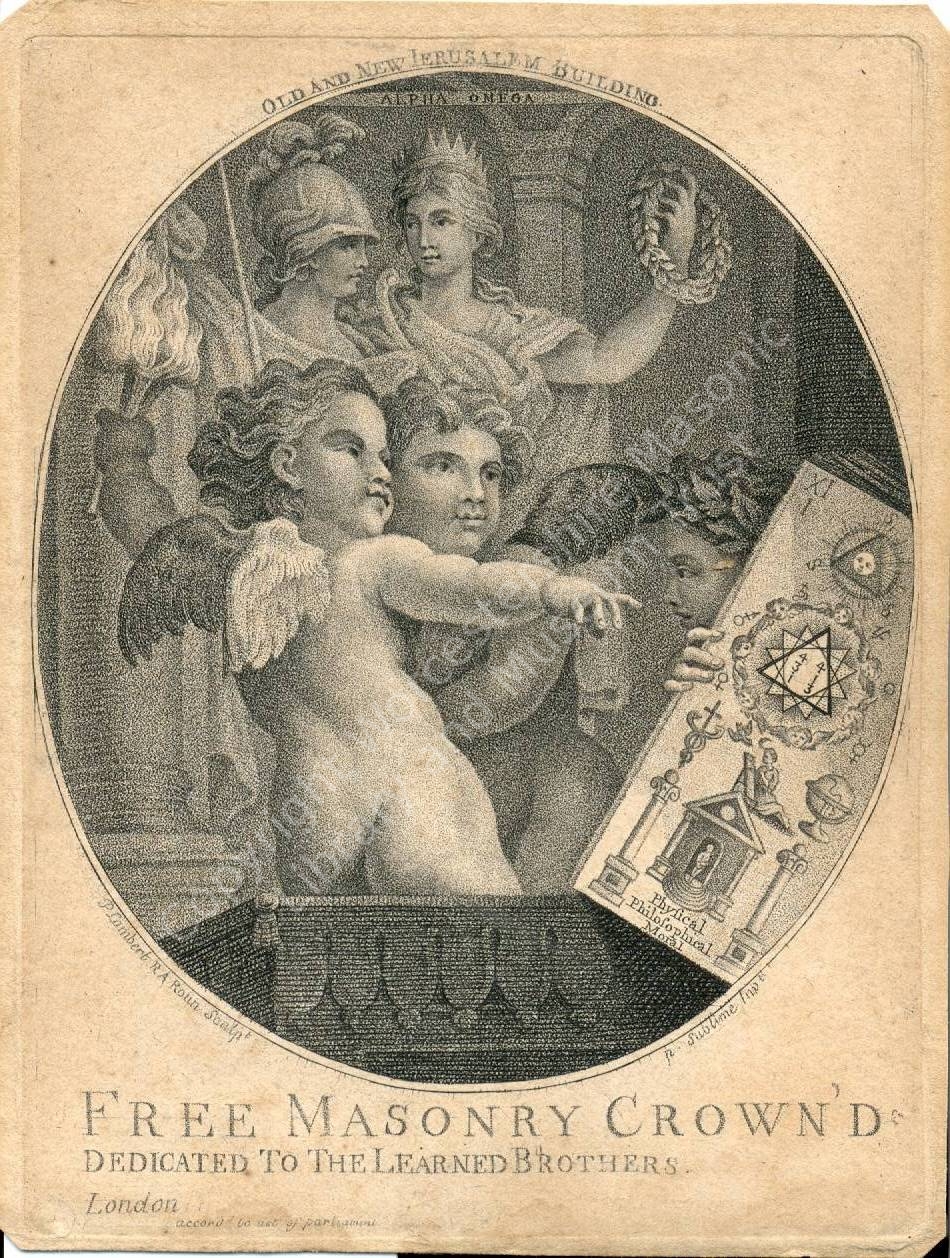
Free Masonry Crown’d - P Lambert c1787
Date:- 1787
WMLMT Classification:- Engraving
Description
"The French / English engraver Peter Lambert (also known as Pierre Lambert de Lintot) is best known for his Masonic engravings
The etching is titled at the bottom ‘FREE MASONRY CROWN’D’, and subtitled ‘DEDICATED TO THE LEARNED BROTHERS’.
The top of the print is inscribed ‘OLD AND NEW JERUSALEM BUILDING’, and the top of the oval ’ALPHA OMEGA’ (God). These inscriptions refer to the beliefs of Swedish scientist and mystic Emanuel Swedenborg (1688-1772) for whom the contrast between the Old and New Jerusalem represented the transition from corrupt traditional Christianity to a prophesied new spiritual era. His work was translated into English by the British artist and poet William Blake in the 1780’s.
The idea of the New Jerusalem is based on the Revelation of St. John the Divine chapters 21-22, which starts off as follows: ‘And I saw a new heaven and a new earth: for the first heaven and the first earth were passed away; and there was no more sea. And I John saw the holy city, new Jerusalem, coming down from God out of heaven, prepared as a bride adorned for her husband’. The New Jerusalem therefore comes from heaven as the dwelling place of the redeemed humanity with God - the union of heaven and earth, or of the bride with her husband Christ, and echoes God’s Old Testament promises to dwell with his own people Israel (Ezekial 37:27-8 Zecheriah 8:8) and also that many nations will be his people with whom he will dwell (Zechariah 2:10-11, Isaiah 19:25, Amos 9:12).
The main picture is an allegorical design. At the top left stands a helmeted female figure holding a staff or spear, most likely representing Athena the goddess of wisdom and good counsel. To her right stands a crowned female figure, and although not winged and the same size as Athena, she most likely represents Nike the goddess of victory, holding a laurel wreath - a symbol of triumph.
Athena and Nike are looking at each other and are closely linked in Greek mythology, with Nike often being portrayed as an attribute of Athena (Athena Nike / Athena of Victory), and together symbolise both wisdom and success.
There are two cherubs on a parapet in the foreground, partly obscuring the female figures, one holding a flaming torch and pointing to a large book decorated with masonic symbols lettered 'Physical / Philosophical / Moral', from behind which peers a small boy wearing a laurel wreath. At the top of the page is a triangle within a circle of rays depicting God’s eternal glory, and the eternal light of His wisdom.
The next line shows a circle of seven winged cherub heads, enclosing an irradiated twelve-pointed star (dodecagram), within which are 2 columns numbered 4 3 1 and 4 1 3. The symbol’s intended meaning is unclear, but may represent God's people because Israel was comprised of 12 tribes (OT), or the church which was built upon the life and ministry of the 12 apostles (NT), or the 12 signs of the zodiac / months of the year etc.
Below, the two snakes entwined on the staff represent Hermes’s caduceus, signifying immortality, guidance, and peace. To the right of the caduceus there is a dove, a woman either weaving or playing an instrument, and a globe.
At the bottom of the page the temple entrance has 7 steps, and is flanked by 2 Ionic columns each surmounted by a globe. The bottom of oval is inscribed 'P Lambert RA Roun sculpt / p. Sublime invt', and the bottom of the print is inscribed 'London / accordg to act of parliament.'."
Use Your Browser Back Button to Return to Previous Page
Quick Links:- Return to Picture and Print Collection - Browse All the Museum Collections
